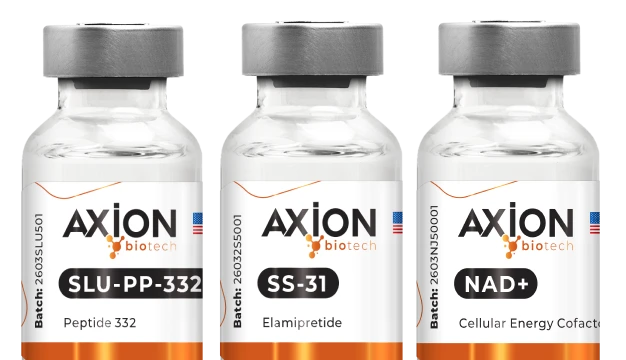
SS-31
(Elamipretide)


-
SystemMitochondrial Energy System
-
TypeSynthetic tetrapeptide - Szeto-Schiller class
-
SynonymsElamipretide, MTP-131, Bendavia
-
SequenceD-Arg-2’6’-Dmt-Lys-Phe-NH₂
-
Mol. weight639.8 Da
-
FormLyophilized vial
-
Purity>98% by HPLC
-
StatusActive

SS-31 Overview
SS-31 is a synthetic tetrapeptide belonging to the Szeto-Schiller class — a family of aromatic-cationic peptides developed for their intrinsic mitochondrial selectivity. Also known as Elamipretide or MTP-131, the compound is classified within AXION's Mitochondrial Energy System based on its primary mechanism: selective interaction with cardiolipin, a phospholipid exclusive to the inner mitochondrial membrane.
The structural basis of SS-31's selectivity is its alternating aromatic and positively charged residues, which confer high affinity for the anionic cardiolipin surface — without requiring a carrier or conjugate.
This intrinsic targeting mechanism is a substantive distinction from conventional antioxidant strategies, which broadly distribute throughout the cell. SS-31 concentrates directly at the site of mitochondrial ROS production.
Among peptides studied in research contexts, SS-31 carries a notable distinction: it is the compound in AXION's Mitochondrial Energy System with the most advanced clinical stage — with Phase III trials underway under the name Elamipretide for heart failure with preserved ejection fraction (HFpEF). It is one of the mitochondrial peptides with the highest volume of peer-reviewed literature available, spanning from foundational mechanistic studies to Phase II clinical data.


SS-31 Research Directions
The published literature on SS-31 spans over two decades and multiple biological contexts centered on mitochondrial dysfunction. Below is an overview of the principal research areas documented in preclinical and clinical studies.
- Cardiac ischemia-reperfusion — cardioprotection models, infarct size reduction, post-ischemic mitochondrial function
- Heart failure with preserved ejection fraction (HFpEF) — Phase II and Phase III clinical trial contexts (Elamipretide)
- Renal ischemia-reperfusion and acute kidney injury — cardiolipin interaction as the mechanistic anchor
- Mitochondrial aging and sarcopenia — preservation of bioenergetic capacity in muscle tissue models
- Neuroprotection and neurodegenerative models — oxidative stress reduction at the mitochondrial site
- Barth syndrome (genetic cardiolipin disorder) — Phase II/III clinical context with highest mechanistic specificity
- Metabolic dysfunction and mitochondrial disease — broader disease contexts where ETC impairment is central
SS-31 selectively binds cardiolipin on the inner mitochondrial membrane, preventing ROS-induced peroxidation and preserving cristae architecture. Cardiolipin is essential for the structural organization and function of the respiratory chain complexes.
By stabilizing cardiolipin, SS-31 improves the physical coupling between ETC complexes I, III, and IV, enhancing oxidative phosphorylation efficiency and ATP synthesis — without artificially driving the system.
The aromatic residues of SS-31 directly scavenge superoxide and hydroxyl radicals at the inner membrane — at the precise site of production. Unlike systemic antioxidants, this action does not interfere with physiological redox signaling.
By stabilizing cardiolipin, SS-31 improves the physical coupling between ETC complexes I, III, and IV, enhancing oxidative phosphorylation efficiency and ATP synthesis — without artificially driving the system.

Related Compounds Compounds in the Mitochondrial Energy System
All compounds below belong to the same biological system as SS-31. Each is supplied as an RUO research compound.
MOTS-c
Mitochondria-derived peptide (MDI). Investigated for systemic energy signaling via AMPK pathway activation and nuclear gene expression regulation. Research context overlaps with SS-31 in aging and metabolic models — complementary mechanisms: MOTS-c via systemic AMPK; SS-31 via inner membrane structural stabilization.
View molecule
MOTS-c
Mitochondria-derived peptide (MDI). Investigated for systemic energy signaling via AMPK pathway activation and nuclear gene expression regulation. Research context overlaps with SS-31 in aging and metabolic models — complementary mechanisms: MOTS-c via systemic AMPK; SS-31 via inner membrane structural stabilization.
View molecule
MOTS-c
Mitochondria-derived peptide (MDI). Investigated for systemic energy signaling via AMPK pathway activation and nuclear gene expression regulation. Research context overlaps with SS-31 in aging and metabolic models — complementary mechanisms: MOTS-c via systemic AMPK; SS-31 via inner membrane structural stabilization.
View molecule
MOTS-c
Mitochondria-derived peptide (MDI). Investigated for systemic energy signaling via AMPK pathway activation and nuclear gene expression regulation. Research context overlaps with SS-31 in aging and metabolic models — complementary mechanisms: MOTS-c via systemic AMPK; SS-31 via inner membrane structural stabilization.
View molecule
Related Articles - Research Library Explore the Science Behind This System
The Research Library provides in-depth editorial coverage of the mechanisms, evidence, and investigative directions relevant to this system. Each article connects to one or more related compounds in the AXION catalog.